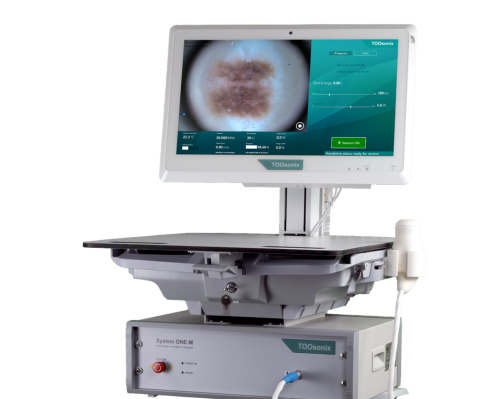
System ONE-M

Intended purpose

System ONE-M is intended for treatment of the human epidermis and dermis layers by administering high-intensity focused ultrasound (HIFU) doses to small and confined volumes in the human skin

Intended users

System ONE-M is used by qualified and trained healthcare professionals who may preferably have past experience with ultrasound, laser, electrotherapy, photodynamic therapy or similar clinical practices.

Intended patient population

The patient population is adults (18 years and above).

Indication for use

System ONE-M is indicated for medical and aesthetic dermatological therapy including, but not limited to, the following general categories:

Medical indications:

  • WHO ICD11: 2C32 
  • The most common malignancy in humans, light induced, increasing prevalence. 
  • Treated in public hospitals and private clinics in all EU countries. 
  • WHO ICD11: EK90.0 
  • Pre-cancerous condition with known potential to transform into skin cancer, basal cell carcinoma or squamous cell carcinoma (BCC or SCC).  
  • Treated in public hospitals and private clinics in all EU countries.  
  • WHO ICD11: EF20.Z, not specified according to subtypes. 
  • Pathologies of the vascular and capillary network of the outer skin; size may range from small to large and segmental with major social impact.  
  • Severe and/or sensitive cases on visibly exposed sites are covered by public health care treatment such as lasers in EU countries. Lasers may not be effective and 2nd line treatment by focused ultrasound rational. 
  • Non-eligible conditions small in size and without medico-social implication are frequently treated in private clinics on personal payment. 
  • WHO ICD11: 2F24 
  • The most common genetically determined skin disease, also named Recklinghausen´s disease. Tumors may be counted in hundreds, and there is a special need for field eradication by minimally invasive method. Surgery and lasers cause scaring. Many also have internal fibromas in the nervous system.  
  • Treated in public hospitals and private clinics in most EU countries. 
  • WHO ICD11: 1E80  
  • Manifestation of a viral HPV infection in the skin. 
  • Recalcitrant cases are treated in hospitals or dermatology clinics covered by public health in all EU countries. 
  • Solitary warts and mild cases are often treated by general practitioners, nurses, in private clinics on personal payment, or as self-administered treatment at home. 
  • WHO ICD11: 1A95 
  • Symptom of a sexually transmitted HPV viral infection.  
  • Frequently treated in out-patient clinics or STD clinics covered by the public health system. 
  • WHO ICD 11: ED80.1 
  • Inflammatory state of the skin, sebaceous glands.  
  • Of huge psychological impact in youngsters. Face and upper trunk affected.  
  • Severe cases are covered by the public health system in most EU countries. 
  • Non-eligible conditions are treated by personal payment in private clinics or managed by sufferers themselves with or without acceptable result. 
  • WHO ICD11: 2F21.0 
  • Benign, and extremely common age-related skin condition that may have high socio-physiological impact  
  • Many lesions appearing in a short while may mark internal organ malignancy (sign of Leser-Trélat), and diagnosis by dermatologist and evaluation by internist indicated with no delay.  
  • Frequently treated in private clinics on personal payment. 
  • WHO ICD11: EF20.Z, but unspecific 
  • Benign, small, and common skin condition that that may have high socio-physiological impact  
  • Frequently treated in private clinics on personal payment. 
  • WHO ICD11: ED91.1 
  • Benign, small, and common skin condition that may have high socio-physiological impact  
  • Frequently treated on personal payment in private clinics. 

(e.g. hidrocystoma, Fox Fordyce Disease, Birt-Hogg Dubé syndrome, epidermal inclusion cysts, etc)  

  • WHO ICD11: 2F2Y, but unspecific   
  • Group of relatively rare benign skin abnormalities that can involve a disruption in the normal functioning of the body or mind depending on the extend; particularly if affecting the face.  
  • Severe cases are treated as a part of public standard care in EU countries. Diagnosis difficult and only dermatologists are capable in concluding such cases.
  • Non-eligible conditions are frequently treated in private clinics on personal payment. 
  • WHO ICD11: EF20.Z, but unspecified. Coding covering different entities. 
  • Benign, small, and very common skin condition in the elderly that may have high socio-physiological impact  
  • Frequently treated on personal payment in private clinics. 
  • WHO ICD11: EK71.0 
  • Benign, small, and common skin condition that that may have high socio-physiological impact  
  • Frequently treated on personal payment in private clinics. 
  • WHO ICD11: EJ20.1  
  • Benign, small, and extremely common skin condition in the elderly that that may have high socio-physiological impact 
  • Frequently treated on personal payment in private clinics. 
  • WHO ICD11: EJ20.0, not specified by subtypes. 
  • Benign, small, and physiologic skin condition associated with chronological age and sun exposure that that may have high socio-physiological impact. 
  • Frequently treated on personal payment in private clinics. 

and tattoos not responding to laser removal  

  • WHO ICD11: N/A, unspecified aesthetic condition that may have high socio-physiological impact 
  • Frequently treated by lasers on personal payment in private clinics. 
  • WHO ICD11: 2F2Y, not specified in subtypes 
  • Group of purely aesthetic skin conditions out of personal preferences and perception. 
  • Frequently treated on personal payment in private clinics. 

Non-medical (aesthetic) conditions*:

  • WHO ICD11: EF20.Z, but unspecified. Coding covering different entities.
  • Benign, small, and very common skin condition in the elderly that may have high socio-physiological impact
  • Frequently treated on personal payment in private clinics
  • WHO ICD11: EK71.0
  • Benign, small, and common skin condition that that may have high socio-physiological impact
  • Frequently treated on personal payment in private clinics
  • WHO ICD11: EJ20.1
  • Benign, small, and extremely common skin condition in the elderly that that may have high socio-physiological impact
  • Frequently treated on personal payment in private clinics.
  • WHO ICD11: EJ20.0, not specified by subtypes.
  • Benign, small, and physiologic skin condition associated with chronological age and sun exposure that that may have high socio-physiological impact.
  • Frequently treated on personal payment in private clinics
  • WHO ICD11: N/A, unspecified aesthetic condition that may have high socio-physiological impact
  • Frequently treated by lasers on personal payment in private clinics
  • WHO ICD11: 2F2Y, not specified in subtypes
  • Group of purely aesthetic skin conditions out of personal preferences and perception.
  • Frequently treated on personal payment in private clinics

*System ONE-M is not included in the group of products without a medical purpose mentioned in EU Regulation 2017/745 Annex XVI. Inclusion of treatment of non-medical conditions with System ONE-M does not require conformity assessment with an appropriate level of involvement of a notified body accredited as per the EU Regulation 2017/745. Responsibility for regulatory compliance relating to treatment of non-medical conditions using System ONE-M falls under the sole responsibility of TOOsonix A/S.

Use environment

The use environment is hospitals and private clinics for both medical and non-medical indications/conditions.

System ONE-M is for multiple use, supplied non-sterile, but to be cleaned between use.

*System ONE-M is not included in the group of products without a medical purpose mentioned in EU Regulation 2017/745 Annex XVI. Inclusion of treatment of non-medical conditions with System ONE-M does not require conformity assessment with an appropriate level of involvement of a notified body accredited as per the EU Regulation 2017/745. Responsibility for regulatory compliance relating to treatment of non-medical conditions using System ONE-M falls under the sole responsibility of TOOsonix A/S.

The handpieces for System ONE-M are for multiple use, supplied non-sterile to be cleaned before and after each session.

Expected Clinical Benefits

The expected clinical benefits from treatment by System ONE-M is safe and efficient localized treatment for one or more included indications and conditions as compared to other existing treatments used as standard of care within the field of dermatology (for example laser ablation, cryosurgery, curettage, surgical removal, Mohs surgery, photodynamic therapy, radiation therapy, or topical pharmaceutical agents).

Measurement of both direct and indirect clinical benefits can take several different forms, and is strongly depending on the indication, selected comparator, extend of treatment (size and/or quantity of treatment targets) and objective (medical, cosmetic or social objective).

The expected direct clinical benefits include a favorable measurement of one or more of the following parameters:

  • High curative effect
  • High reduction-effect
  • Reduced pain during treatment
  • Reduced use of pharmaceutical products
  • Substitute ionizing radiation
  • Reduced pain directly after treatment
  • Reduced healing time
  • Good aesthetic result
  • Low recurrence rate

The expected indirect clinical benefits include a favorable comparable measurement of one or more of the following parameters:

  • Reduced level of user-concern
  • Reduced total time spent per patient/subject by the user
  • Reduced time spent on conducting follow-up visits
  • Reduced cost of treatment

Use environment

The use environment is hospitals and private clinics for both medical and non-medical indications/conditions.

System ONE-M is for multiple use, supplied non-sterile, but to be cleaned between use.

*System ONE-M is not included in the group of products without a medical purpose mentioned in EU Regulation 2017/745 Annex XVI. Inclusion of treatment of non-medical conditions with System ONE-M does not require conformity assessment with an appropriate level of involvement of a notified body accredited as per the EU Regulation 2017/745. Responsibility for regulatory compliance relating to treatment of non-medical conditions using System ONE-M falls under the sole responsibility of TOOsonix A/S.

The handpieces for System ONE-M are for multiple use, supplied non-sterile to be cleaned before and after each session.

Principles of operation

HIFU energy from System ONE-M induces a thermal and/or mechanical effect to the human skin, whereby the subsequent natural restoration process activates and replaces damaged tissue. The system operates with four variants of handpieces, which are designed to deliver acoustic energy at nominal depths of 0.8; 1.3; 1.8 and 2.3 mm beneath the skin surface.

Treatment that includes damages to the outer skin typically lead to transport of damaged cells and material to an external wound crust. Treatments that do not damage the outer skin typically lead to an internal transport from the skin through the vasculature, and thereby healing without external wound crust formation.

Contraindications

The System ONE-M is contraindicated as follows:

  • Ophthalmic use or any use causing the acoustic beam to pass into the bulb of the eye
  • Use on subjects less than 18 years at the time of the start of the treatment
  • Female patients who are pregnant, may be pregnant, or lactating
  • Treatment of larger areas with a broken skin barrier, e.g. an open wound or similar
  • Treatment areas located above or adjacent to (<5 cm) an implant (active or inactive)
  • Treatment of subjects with known blood coagulopathy or excessive bleeding
  • Treatments of subjects with a known history of abnormal scar formation (e.g. keloids).

Potential Side effects

Side effects reported during evaluation of the device are generally mild and transient in nature. The following effects have been observed:

  • Wheal-and-flare reaction: A wheal and-flare reaction, characterized by an urticaria-like reaction with whealing in the treated center and flared redness surrounding the treatment area, is a normal and immediate reaction to HIFU treatment. The reaction typically peaks after 5 to 10 min and fades over the subsequent 10 to 30 min with no sequelae.
  • Inflammatory erythema (redness): The specific treated area may exhibit erythema shortly after a treatment. This condition typically resolves within 3 to 72 hours after treatment.
  • Inflammatory edema (swelling): The treated area may exhibit mild edema, both of the treated area and the immediately 1 – 3 cm adjacent area following treatment. This typically resolves within 3 to 72 hours after treatment.
  • Pain: Pain on HIFU is ultra-short and confined to the treated site. Tenderness to the touch is typical and resolves within 2 days to 2 weeks after treatment.
  • Bruising: Mild bruising, which is caused by damage to soft tissue blood vessels, may occur in rare cases and typically resolves within 2 weeks of treatment.
  • Itching: Mild itching may result during the healing phase starting 2 to 7 days after treatment and typically fades within 2 to 4 weeks after treatment.
  • Inflammation: Redness in the treated area is frequent during the entire healing period. Inflammation may persist some months depending on the anatomical site of the treatment and the healing dynamics of the subject. Inflammation normally tapes out over the first 3 to 6 month after treatment but may persist for over 12 months in rare cases.
  • Infection: Infections may result from bacterial intrusion during healing, where the skin barrier is broken. Infections may start within the first 3 weeks after the HIFU treatment. In case subjects suspect infections, they should seek medical advice/assistance as soon as possible.
  • Dyspigmentation: The treatment removes epidermal melanin content in the skin. Dyspigmentation for periods above 12 months may result. Subjects with dark skin types, i.e., Fitzpatrick Type 3 and above may occasionally experience permanent dyspigmentation.
  • Scarring: The possibility for scar formation (which may respond to medical care) may exist if incorrect treatment technique is used. Scars are more likely to form if treated area is subject to infections or insufficient wound care. Patients with tendency for abnormal scar formation have increased risks for scar formation after treatment.